

CRI (colour rendering index) Lighting
The impact of LED on the lighting industry is huge. Now we’re looking forward to the next big revolution, which is almost certainly, Connected Lighting. IoT, the ‘internet of things’, particularly with regards to retail lighting design.
Have you ever brought an item of clothing from a shop only to find it to be a slightly different colour when you go outside? It’s all to do with the ability of artificial lighting to render colours properly.
In this post we help explain one of the fundamental principles of light – colour rendering – and how to know if the light source you choose for your home, shop, restaurant, gallery or office will render colours effectively. It could have a profound effect on the way things look.
Get in touch to find out how we can help with your Lighting Design needs
There has been ongoing debate about the relevance of CRI as a true indicator of defining the ability of an LED to render colours effectively. One reason is because the CRI standard only uses a small number of colour samples. Fittings can achieve a high CRI score (making it an excellent colour rendering product on paper) when it may not actually render many colours well.
High CRI values can fool people because each sample colour is given a score out of 100, then the total is averaged. Some colours will score low and most are not even considered. Awareness of this shortcoming is particularly important when looking at LED light sources which in general have a score of 80 or 90 but often score poorly on the R9 value. When specifying fittings on our projects we always look at extended CRI and each individual R value, particularly the deep red R9 score which has a profound impact on the appearance of skin tones and food.
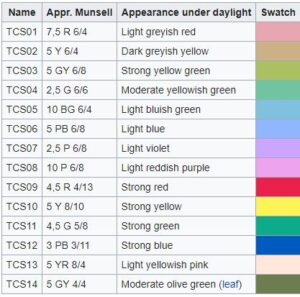
The 8 colour samples
are roughly evenly spaced around Munsell’s colour circle. Unfortunately, these unsaturated pastel colours are not a great representation of typical colours we find in our environment, so these 8 sample colours are often extended to include an additional 6; R9-R14 which include more vivid colours such as deep red (R9) and strong blue (R12). Understanding how a light source will render these ‘extended CRI’ colours is important.
Light scored at the high end of the scale (>90) will render colours more accurately. It’s important to note, an Ra value refers to the average score across only 8 colour samples (R1-R8). The term CRI is often used to describe the Ra value, but this is not always the case. Some manufacturers use the term CRI to describe extended CRI (R1-R14), so when looking at a given CRI value it’s important to understand whether this reflects the extended version or not.
“In an ideal world all light sources would have a CRI of 100. The reality is that high CRI LED’s can 1/ have a reduced light output and 2/ make the light source more expensive. Excellent colour rendering is not always required (particularly in warehouses and even exterior lighting schemes). In fact, LED light sources with an Ra of 80 are commonly used in offices or residential spaces and often perfectly acceptable. That said, it’s important to use the best CRI you budget permits, particularly when lighting bathrooms, kitchens, artwork, restaurants and retail spaces.” Lighting Design Supply Team
There has been ongoing debate about the relevance of CRI as a true indicator of defining the ability of an LED to render colours effectively. One reason is because the CRI standard only uses a small number of colour samples. Fittings can achieve a high CRI score (making it an excellent colour rendering product on paper) when it may not actually render many colours well.
High CRI values can fool people because each sample colour is given a score out of 100, then the total is averaged. Some colours will score low and most are not even considered. Awareness of this shortcoming is particularly important when looking at LED light sources which in general have a score of 80 or 90 but often score poorly on the R9 value. When specifying fittings on our projects we always look at extended CRI and each individual R value, particularly the deep red R9 score which has a profound impact on the appearance of skin tones and food.